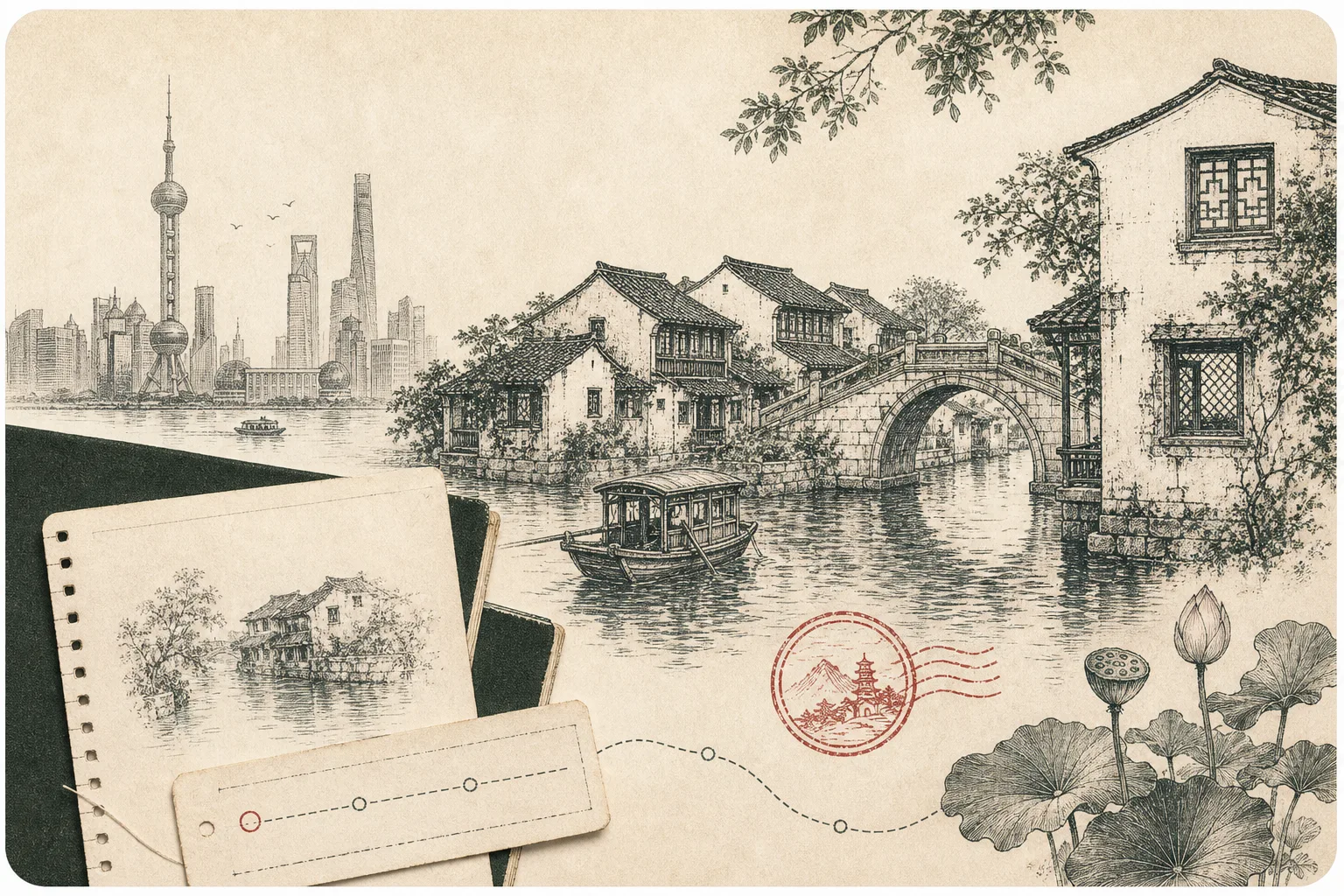
Forty-eight hours in Shanghai can reveal far more than its skyline if each half-day stays geographically coherent. The city rewards contrast: the Bund's financial architecture facing Pudong, intimate lilong lanes near broad commercial streets, and older religious or market spaces woven into a modern metropolis.
This plan uses one day for the Huangpu River and historic center, then a second for neighborhood-scale Shanghai and one chosen museum or contemporary district. Reservations, museum closure days, tower access, and river conditions remain changeable, so confirm the details on official sites.
- Useful base
- Near a central metro interchange, not necessarily on the Bund
- Day one
- Bund, selected old-city context, and Pudong after dark
- Day two
- Neighborhood walk plus one museum or cultural focus
- Transport
- Metro for distance, walking within compact clusters
Arrive with a small map of priorities
Shanghai has multiple airports and railway stations, so a two-day stay begins with choosing accommodation that simplifies your actual arrival and departure. A hotel near a useful metro line often saves more time than one beside a single famous view. Check last-train information if arriving late.
Choose one weather-dependent skyline moment, one museum or ticketed interior, and two walking areas. Everything else is optional. This keeps a delayed flight or rainy morning from collapsing the entire itinerary.
Day one morning: read the Bund closely
Walk the Bund early, before the promenade becomes busiest. Look both across the river and back at the former banks, trading houses, consulates, and hotels whose façades record Shanghai's treaty-port economy. The architecture is visually impressive but belongs to a history of unequal foreign power as well as commerce.
Continue into nearby streets rather than remaining on the waterfront for hours. Short detours reveal how wholesale trade, offices, residential blocks, and renovated heritage sit behind the grand frontage. Enter only buildings clearly open to the public.
Day one afternoon: add an older layer
Choose one old-city focus such as a public garden, temple, or historically interpreted street area. Popular precincts can be crowded and extensively commercialized, yet they still provide clues to urban form and religious practice when you move beyond souvenir expectations.
Ticketing and reservation requirements for major gardens or temples may change. Check official information, eat lunch outside peak time, and preserve energy for the evening. Do not schedule several similar shopping streets simply because they appear in separate guide lists.
Day one evening: cross the Huangpu once
Use the metro, public ferry where convenient, or another legal river crossing to reach Pudong. A tower observatory can provide perspective, but choose only one and reserve if required. On cloudy days, a ground-level riverside walk may be more satisfying than paying for a view inside fog.
After the lights come on, stay long enough to enjoy the skyline and then return without chasing multiple viewpoints. Ferry hours, cruises, and lighting schedules are operational details; verify them rather than building the night around an old timetable.
Day two: slow down to neighborhood scale
Spend the morning in a walkable area of former lane housing, tree-lined streets, markets, and small public spaces. The western former concession area is a common choice, but it is large; select a short route around two or three streets and a public cultural site.
Remember that lilong lanes often remain residential. Do not enter gated compounds without permission or photograph through windows. The aim is to notice Shanghai's domestic scale and patterns of reuse, not to collect private courtyards.
Finish with one deeper interest
Use the final afternoon for one major museum, an art district, a design or architecture site, or a food-focused neighborhood. Check closure days and reservation rules first. A focused indoor visit also protects the itinerary from heat, humidity, or rain.
Leave a generous transfer to your departure station or airport. Shanghai distances and large terminals punish tight timing. If staying another night, end with a simple neighborhood dinner rather than commuting across the city for a single recommendation.
Notebook check
- Cross the river once as part of a planned loop, not repeatedly for views.
- Use one ticketed interior per day as the schedule anchor.
- Keep the final hours close to the transport line you need next.
The useful takeaway
In 48 hours, Shanghai comes together at three scales: river and skyline, historic urban fabric, and neighborhood life. Group each scale into a compact block and leave room for weather, reservations, and the city's long transfers.