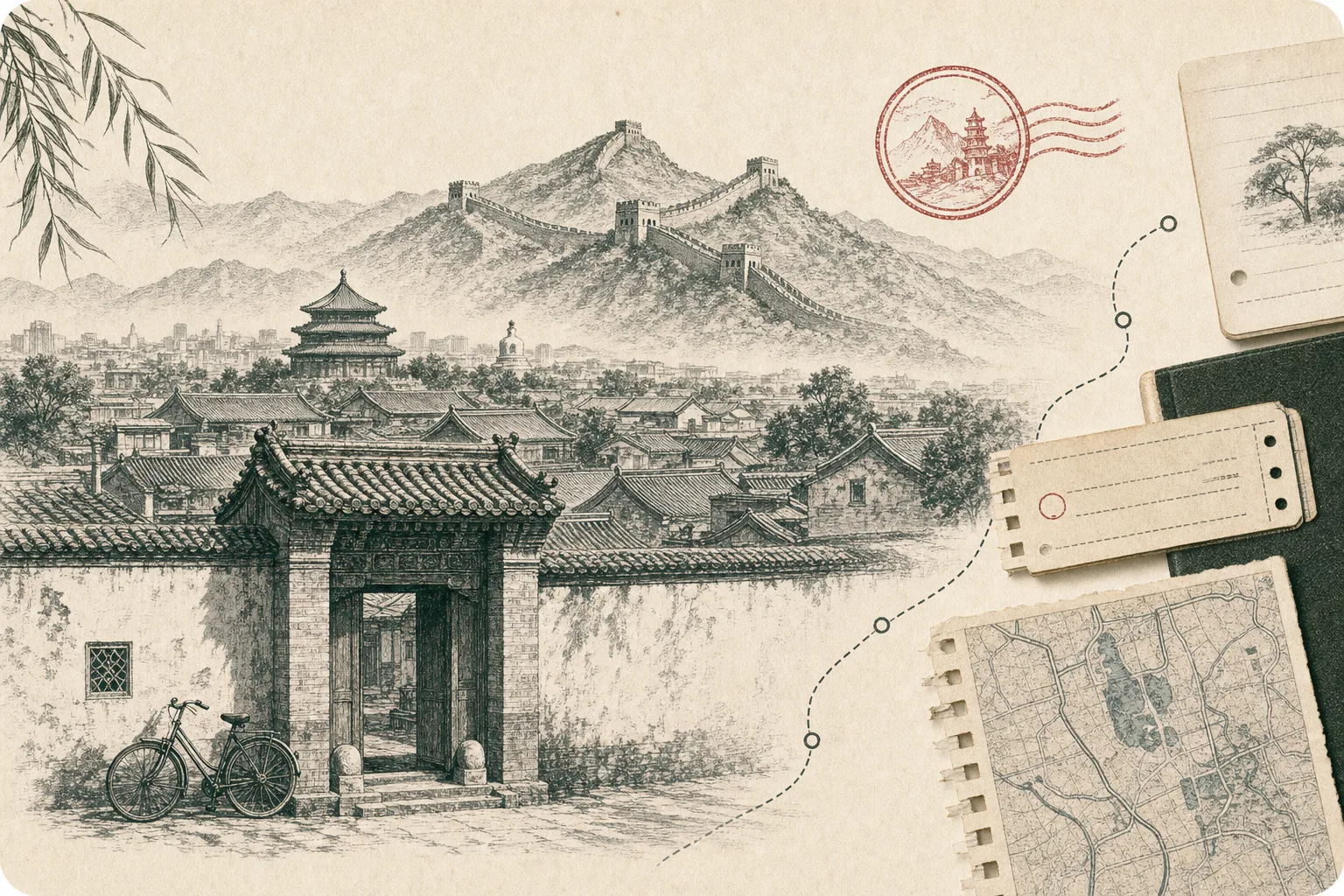
Beijing's hutongs make the most sense at walking speed. Their interest lies in transitions: a ceremonial gate beside a bicycle repair stand, old courtyard walls facing new businesses, and quiet lanes opening suddenly onto busy roads. A slow day lets those contrasts emerge without turning residents' doorways into attractions.
Rather than chasing one perfect route, choose a compact area with public sights, connect it to a park or temple, and leave room for tea and detours. The most rewarding itinerary is modest in distance and careful about privacy.
- Visiting style
- Walk one compact district with frequent pauses
- Good pairing
- A public temple, lakefront, museum, or neighborhood park
- Courtesy
- Treat courtyards and narrow alleys as residential space
- Navigation
- Save Chinese place names and a working offline map
Pick a neighborhood, not a greatest-hits circuit
The broad area around the Drum and Bell Towers, Shichahai, and nearby lanes is convenient for a first exploration because public landmarks help with orientation. It can also be busy. Quieter streets are often only a few turns away, but they should be discovered without trespassing through courtyard gates or following residents for photographs.
Another option is to build the day around the Lama Temple and Confucius Temple area, then walk selected lanes nearby. This gives the day a clear cultural anchor and avoids spending hours looking for an allegedly secret alley described in an outdated post.
Begin when the streets are waking up
Morning offers softer light, cooler temperatures, and a view of daily routines before entertainment streets become crowded. Start with a public square, park, or major lane where your presence is expected. Notice street width, rooflines, gate orientation, and the way larger compounds sit within the grid.
Breakfast can be simple and spontaneous, but use normal traveler judgment about hygiene and payment. You do not need to hunt for a single famous shop. A busy counter with clearly displayed food and prices can provide a more relaxed introduction than a long queue built by social media.
Use public interiors to understand courtyard life
Most siheyuan courtyards are private homes or businesses, so the street alone cannot explain how the architecture works. A legitimate museum, former residence, temple, or cultural venue can provide interior context without invading anyone's space. Check its official opening information because small sites often keep limited schedules.
Once you have seen a public example, details outside become easier to read: screen walls, gate stones, reused timber, and layers of repair. Remember that today's hutongs have been altered repeatedly. Their value does not depend on pretending every visible surface is ancient.
Let lunch divide the day
Plan a genuine break rather than eating while walking. Choose a place where you can sit, warm up or cool down, and review the second half of the route. If a lane has become overwhelmingly crowded, lunch is the moment to redirect toward a park or a parallel street.
Neighborhood food changes with rents and residents, so avoid treating one snack as the authentic essence of hutong life. Ask what is available, be flexible, and keep allergy information written in Chinese when necessary. Paying attention to ordinary service rhythms is part of traveling independently.
Add water, trees, or a viewpoint
In the afternoon, connect the lanes to Shichahai's public waterfront, a local park, or the Drum and Bell Tower area according to current access. These open spaces provide orientation after enclosed alleys and reveal how neighborhood routes relate to the old city's larger plan.
If you rent a bicycle, use designated services and ride conservatively; narrow lanes mix pedestrians, residents, delivery vehicles, and parked bikes. Walking is often easier for visitors because it permits sudden stops without obstructing traffic.
Photograph with restraint
Ask before making a person the subject of a photograph, and do not aim a camera through open doors or windows. Keep voices low in residential lanes, yield to working vehicles, and avoid blocking entrances while arranging group portraits. Commercial photo sets are not evidence that every surrounding home is public.
End the day before fatigue makes you careless. Save the nearest metro entrances and order a car only from a place where stopping is legal and obvious. Hutongs reward attention, and attention is easier when the route contains fewer targets.
Notebook check
- Use public cultural sites for courtyard interiors.
- Photograph architecture freely only from public space; ask before photographing people.
- Keep the route compact enough that you can change course without pressure.
The useful takeaway
A hutong day succeeds through observation rather than coverage. Choose one district, enter only public spaces, pause often, and remember that the lanes are valuable precisely because people still use them as part of everyday Beijing.