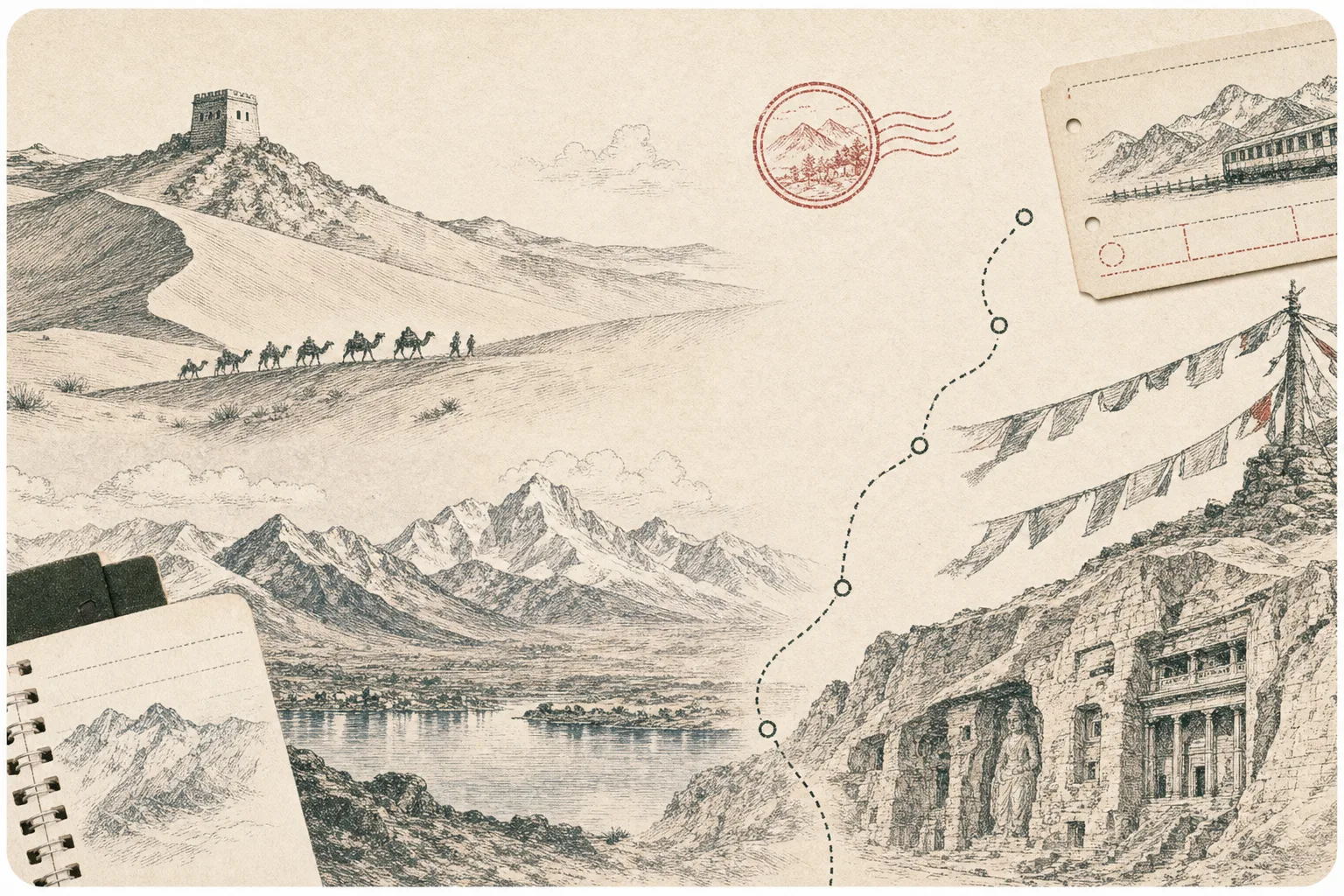
The Hexi Corridor carries railways and roads northwest between high plateaus and desert, following an ancient passage that connected central China with the wider Silk Roads. Modern travelers encounter a sequence of distinct places rather than one scenic highway: Lanzhou as a transport threshold, Wuwei's historical layers, Zhangye's temples and geology, Jiayuguan's frontier complex, and Dunhuang's Buddhist art and oasis landscape.
Seven to ten days is a useful range, with fewer stops at the shorter end. The central planning principle is to alternate major historical sites with landscapes and recovery time. Train schedules, museum closures, scenic buses, and seasonal access can change, so anchor the route in China Railway and official attraction information rather than a fixed list of departures.
- Useful duration
- Seven to ten days from Lanzhou to Dunhuang
- Best direction
- Either works; westbound tells a clear story
- Transport
- Rail between cities, road for final attractions
- Climate
- Dry air, strong sun, wind, and cold nights
Choose four anchors, not every stop
A strong first journey might use Lanzhou, Zhangye, Jiayuguan, and Dunhuang, adding Wuwei only with enough time for its museums and tomb history. Skipping a city is not a failure; repeated one-night stays blur the corridor's different periods and turn every morning into luggage management.
Give Dunhuang at least two full days because Mogao reservations and desert weather impose their own rhythm. Zhangye benefits from one city day and one landscape outing. Jiayuguan can be focused into a long day, although an extra night protects onward rail connections and allows several frontier sites without rushing.
Use rail for the spine
Daytime trains reveal the transition from settled valleys to increasingly arid country, while overnight services can preserve daytime at the cost of sleep. Mix them rather than automatically choosing the fastest option. Check whether your train uses a central station or a newer high-speed station outside town.
Road transfers remain necessary for landforms, frontier ruins, and some cave sites. Agree on a licensed vehicle, clear itinerary, waiting time, and return point. Keep a large buffer before onward trains because attraction exits, scenic shuttles, and rural traffic are not synchronized with the national rail timetable.
Build a coherent historical thread
Begin with a regional museum or city museum to understand why the corridor mattered for military control, migration, religion, trade, and artistic exchange. At Jiayuguan, distinguish the restored fortress, Great Wall sections, and associated sites rather than imagining one untouched wall extending through the desert.
Mogao then makes more sense as part of long cultural networks, not an isolated collection of paintings. Read current archaeological interpretation and avoid repeating simplistic stories of a single road carrying goods in one direction. The corridor's history is also local, shaped by communities who lived, farmed, worshipped, and governed there.
Treat landscape excursions as full outings
Zhangye's colorful Danxia landforms lie outside the city and are experienced through managed viewing platforms and shuttle routes. Light and weather affect color, but no sunset is guaranteed. Other canyon or grotto excursions may point in different directions and should not be casually combined.
Around Dunhuang, desert-edge and frontier routes involve longer drives than map thumbnails suggest. Carry water and layers, yet follow site rules about food, drones, and off-path access. Do not climb fragile formations or enter closed ruins. Wind warnings should override a planned photograph.
Plan for aridity and distance
Use sunscreen, sunglasses, lip balm, and a refillable water bottle, and drink regularly without forcing excessive water. Summers can be fiercely hot while winters are cold; shoulder seasons still bring large day-night differences. Dust and wind make a sealed pouch useful for passports and electronics.
Keep one flexible half day every few stops for laundry, a delayed train, or simple fatigue. Food and hotel options are broad in larger cities but thinner on rural excursions, so carry snacks and essential medication. This margin is what turns the route from a transport challenge into a connected journey.
The useful takeaway
Build the Hexi Corridor around four well-spaced bases, use rail as the spine, and reserve road excursions for one direction at a time. Alternate museums and monuments with outdoor landscapes, protect the fixed Mogao booking, and leave enough blank space for desert weather and long final transfers.